



TL;DR
Context
Scintilla already offered customizable boards, metric alerts, reports, and customer research, but these capabilities existed as separate destinations. Users had to move between products, manually configure analyses, interpret results, and reconnect context on their own. Meanwhile, AI experiments were emerging independently across product teams, creating inconsistent patterns and fragmented agent experiences.
Outcome: a unified agentic system built to scale
The work established a unified agentic system designed to make Scintilla an intelligent, personalized business partner. Suppliers and merchants could begin with a natural-language question and move from insight to decision to action within one continuous experience.
The redesigned experience increased 30-day retention among new users by 23%. As suppliers shifted routine analysis into the agentic experience, usage of equivalent manual workflows decreased by 32%, while total queries per weekly active user increased by 41%. Together, these signals showed that users were returning, relying less on manual setup, and engaging more deeply through conversation.
The challenge
Scintilla’s capabilities were previously split across separate tools, requiring users to switch contexts and rebuild their analysis repeatedly. AI features were also developed in silos, leading to inconsistent experiences, duplicated effort, and fragmented context across products.
The north star
The vision for Scintilla AI is to become an intelligent operating layer for supplier growth at Walmart. Users should be able to ask natural-language questions and receive clear, contextual answers that lead directly to action. The system should act as a trusted partner from question to decision.
AI experience principles
I defined four principles for a unified AI experience: persistent context, conversational exploration, explainable action, and personalized outputs.
- 01Persistent context
Remember prior work, business context, and user intent across products.
- 02Conversational exploration
Support follow-up questions, deeper investigation, and let users refine analysis without restarting context.
- 03Explainable action
Show the supporting data and reasoning behind each response and recommendation before users review or approve an action.
- 04Personalized outputs
Tailors insights and recommendations based on the user’s role, business priorities, and history.
Turn a business question into a dashboard
The investigation experience lets users begin with a natural-language business question, receive an answer grounded in their data, explore contributing factors, and turn the findings into a dashboard they can save and refine.
In-context analysis
In-context AI within a board lets users summarize performance, investigate underlying drivers, and turn findings into actions such as alerts without leaving the board. The system preserves the business context that initiated the task, gathers missing details through conversation, prepares an alert for review, and supports further refinement before activation.
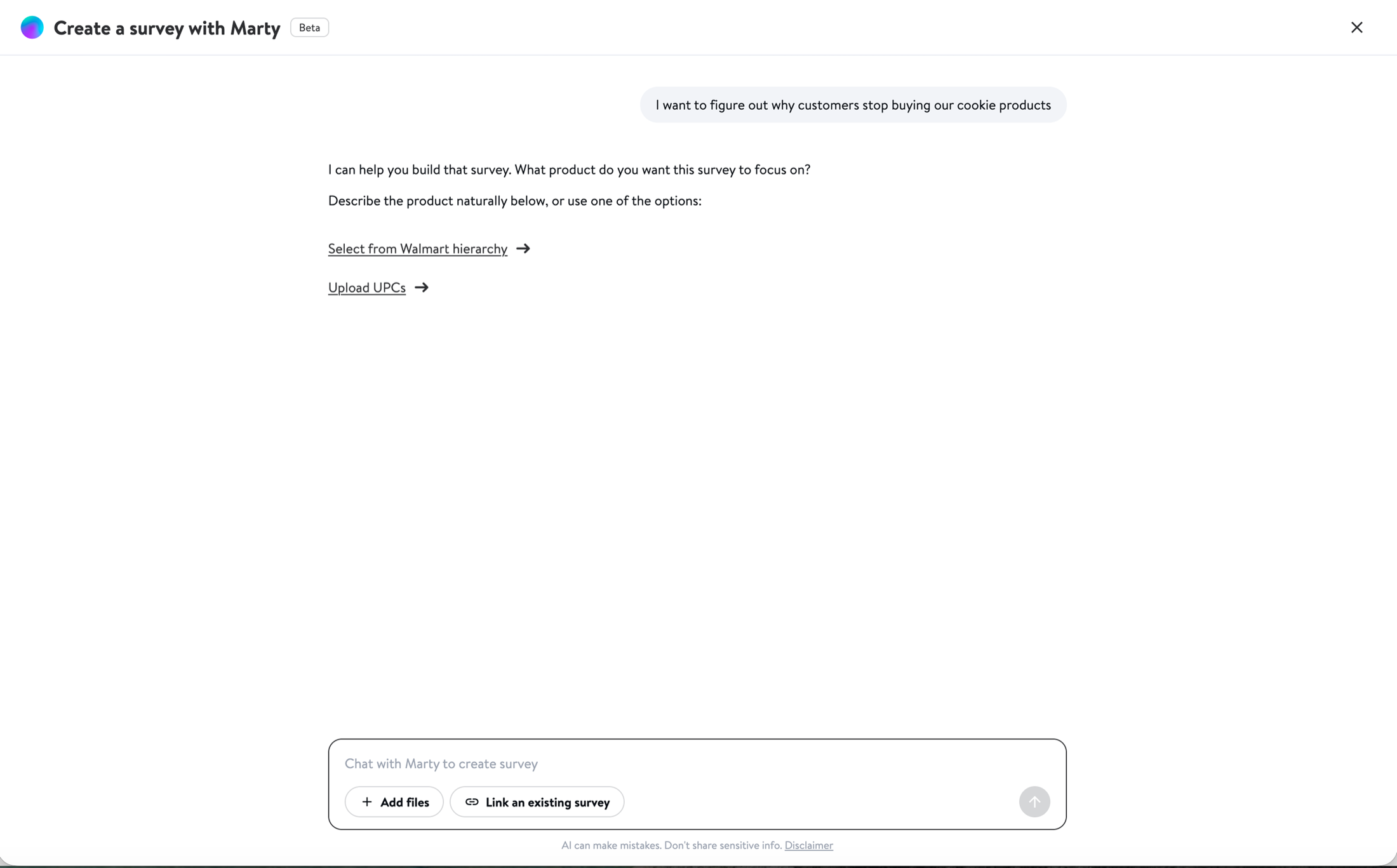
AI-assisted customer research
The research experience transforms a natural-language objective or business question into a structured, editable survey. AI clarifies the research goal and target audience, generates a relevant draft, and helps users review and refine the survey while keeping them in control of the final research design.